Antipode of Australia – What Part of the World is Opposite of Australia?
Answer: Nearly all of Australia's antipodal points lie in the North Atlantic Ocean. The only Australian territory with a land-based antipode is Christmas Island, whose opposite point overlaps with a small area (approximately 136 km²) in northern Colombia, South America.
Which Australian State and Territory Antipodes Align with Other Landmasses on Earth?
Of all Australian states and territories, only Christmas Island has an antipodal point that overlaps with land. Christmas Island is an Australian external territory located in the Indian Ocean, approximately 350 km south of Java, Indonesia. When projected through the Earth's center, its antipode lands in northern Colombia, South America, near the Caribbean coast.
The overlap area is approximately 136.14 km², and the antipodal centroid point is located at coordinates 10.49°N, 74.36°W, placing it near the municipality of Pivijay in the Magdalena Department of Colombia. This makes Christmas Island one of the rare places on Earth with a precise land-to-land antipodal connection.
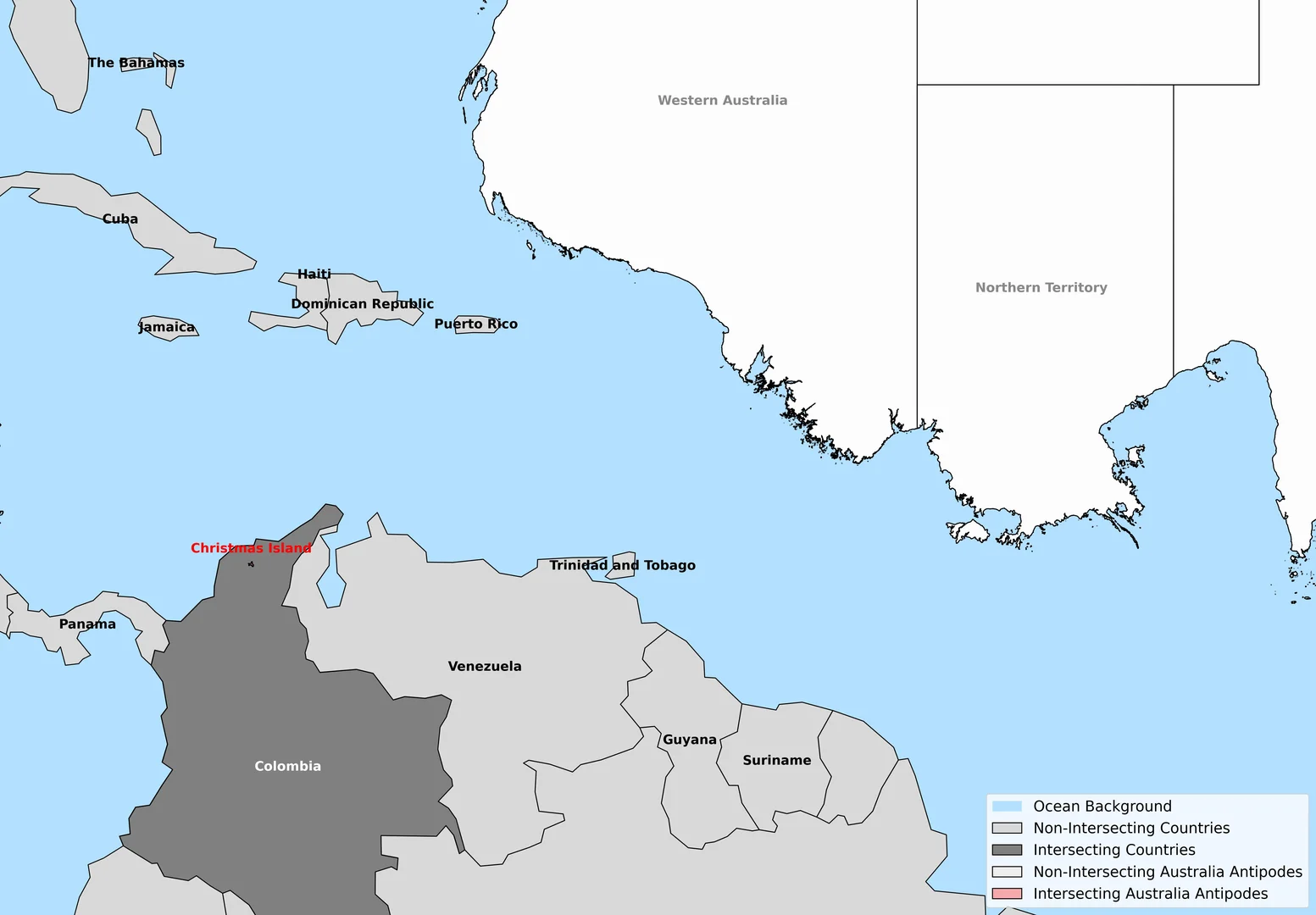
Most Australian Antipodal Points are in the Ocean — Here's Where They Land
The vast majority of antipodal points for mainland Australia and its territories fall within the North Atlantic Ocean. This is because Australia is positioned in the Southern Hemisphere between roughly 10°S and 44°S latitude, and when these coordinates are flipped through the Earth's center, they emerge in the Northern Hemisphere's Atlantic, where landmass is scarce at those corresponding latitudes.
Mainland Australian states such as New South Wales, Victoria, Queensland, South Australia, Western Australia, and the Northern Territory all have antipodes that land squarely in the open Atlantic Ocean, far from any continental shores. Tasmania's antipode falls in the Atlantic as well, roughly between the Azores and the Iberian Peninsula. The external territories—including the Cocos (Keeling) Islands, Norfolk Island, and others—also project into oceanic regions.
The Atlantic Ocean covers approximately 106 million square kilometers, making it the second-largest ocean on Earth. The portion of the Atlantic where Australian antipodes land is characterized by deep ocean basins and minimal island presence, which explains why Christmas Island's small overlap with Colombia is such a geographic rarity. This distribution underscores a fundamental fact about our planet: with over 70% of Earth's surface covered by water, most antipodal pairs involve at least one oceanic point.
What is an Antipode?
An antipode refers to a point on the Earth's surface that is diametrically opposite to another point. Simply put, if you were to draw a straight line from one point on the Earth's surface, through the center of the Earth, to the other side, you would reach the antipode of the original point.
How is an Antipode Calculated?
To calculate the antipode of a given location, a few simple steps are involved:
- For the latitude, simply invert the sign. For example, the antipode of 45° N will be 45° S.
- For the longitude, subtract the longitude from 180° and invert the direction (E becomes W or W becomes E). For example, the antipode of 75° W will be 105° E.
The antipodal point is theoretically precise; however, since the Earth is not a perfect sphere but rather an oblate spheroid, real-world calculations involve geospatial techniques that take into account variations in terrain and the Earth's ellipsoid shape. Additionally, antipodal points are mostly located in the oceans, as water covers more than 70% of the Earth's surface.
Frequently Asked Questions
- What part of the world is opposite of Australia?
- Nearly all Australian antipodes lie in the North Atlantic Ocean. Only Christmas Island has a land-based antipode, overlapping with Colombia.
- Which Australian states and territories have land-based antipodes?
- Only Christmas Island—an Australian external territory in the Indian Ocean—has an antipode that overlaps with land. Its opposite point falls in northern Colombia, with an overlap area of approximately 136 km².
- Where would I end up if I dug straight through the Earth from Sydney?
- If you could dig straight through Earth from Sydney, you would emerge in the North Atlantic Ocean, roughly halfway between Bermuda and the Azores—far from any land.